Platycerium
Platycerium veitchii
silver staghorn fern
- Latin
- Platycerium veitchii
- Chinese
- 立葉銀鹿鹿角蕨
- Japanese
- ベイチー
- English
- silver staghorn fern
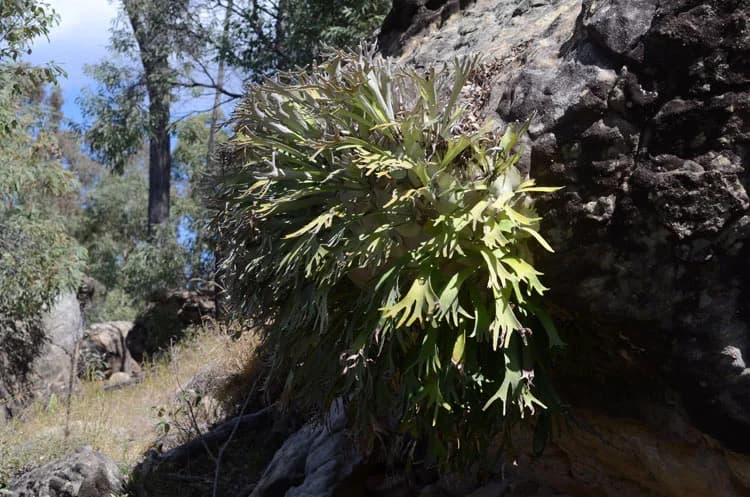
Platycerium veitchii, the silver staghorn fern, comes from dry open woodland in Queensland, Australia, where it grows on rocks as often as on trees. Its narrow fertile fronds stand upright under dense white stellate hairs. It is the most sun-, drought- and cold-tolerant species in the genus, pups freely, and is the source of 'Lemoinei' and the Auburn River form.
Care notes
Native habitat
Platycerium veitchii grows in dry open woodland in Queensland, Australia, on tree trunks and, very often, on exposed rock faces in full sun with little rain and wide day-night swings. The dense coat of white stellate hairs is thought to reflect light and slow water loss. It is generally regarded as the toughest species in the genus.
Light
Among the highest light requirements in the genus. Half to full sun; more light means more upright fronds and thicker silver. Under glass in midsummer, freshly opened fronds can still scorch, so shade lightly at midday. In low light the fronds turn green and flop, and the plant loses the very thing people buy it for.
Water and humidity
Water sparingly. Soak only when the medium is fully dry, and less again in winter. Humidity of 40–60% is enough; a wet, still atmosphere brings brown spotting. A full, deep soak held too long tends to brown and shrivel the edges of the shield fronds; many growers instead let only the base of the board touch the water and lift it once the medium has taken up enough, which tends to be more reliable. Most veitchii die from care, not neglect.
Medium and mounting
Drainage first. Use a small amount of sphagnum cut with bark, tree-fern fibre or coarse grit. A breathable board of modest size suits it, because the plant is slow and compact. Most growers in Taiwan report better results with a thin board and moss laid loose rather than packed tight, letting roots pass through and water drain fast; a thick, rounded moss ball works against it. It pups generously; divide or keep as a clump.
Temperature and seasons (temperate, indoor)
Heat is no problem with airflow. Most growers find the crown only opens up once autumn brings a real swing between day and night temperatures, making that stretch the best window of the year for a full spiked crown to form; give it plenty of light and airflow through those weeks. Cold tolerance is reported to be the best in the genus: growers describe brief dips near 0 °C without loss, though prolonged periods below 5 °C are unwise. In temperate regions it can stay on a sheltered patio into autumn and spend winter in a bright, cool room with almost no water. Do not overwinter it in a warm, dim corner.
Common problems
- Brown spots on fronds: too wet and too still; cut water.
- Fertile fronds green and soft: not enough light.
- Finger-like shield lobes drying: normal ageing.
- Slow growth: normal; do not push it with fertiliser.
Collector notes
Frond expression. How upright the fertile fronds stand, their width, depth of forking, thickness of hair, and the shape of the shield lobes. Trade forms include the typical form, the Auburn River form (a Queensland locality), a 'Wild' form and 'NYX'. 'Lemoinei', long sold as a veitchii and nicknamed the French staghorn fern, is considered by most sources to be a P. veitchii × P. bifurcatum hybrid or selection; its origin is not settled.
Mother plant. Look for fronds that rise evenly, a compact habit and unblemished, uniform silver.
Propagation. Veitchii pups freely, so division is the way to keep a form true. Most growers leave pups on the mother plant to grow on, since they tend to throw a tall crown first this way; dividing only once that crown has set avoids a pup that looks rounded and generic rather than distinctly veitchii. Growth is slow overall — most sources put it at two years or more before a plant shows the species' full character, so patience matters more than fertiliser. Spore culture works but seedlings need higher humidity than adults; switch to dry-side care only once the plant is established.
FAQ
Are silver staghorn, Platycerium veitchii and Auburn River the same plant?
Essentially yes. 'Silver staghorn' is the retail name for P. veitchii, and Auburn River is a Queensland locality form of the same species. The confusion is that 'silver' is also applied to silver-haired P. willinckii selections, so check the Latin name before you buy.
Can Platycerium veitchii take full sun?
Yes; it is among the most sun-tolerant species and grows on bare rock in the wild. Acclimatise it gradually, shade lightly during the hottest midday hours in high summer, especially while new fronds unfurl, and give it as much light as possible the rest of the time.
What is the difference between Platycerium veitchii and 'Lemoinei'?
'Lemoinei' is an old European selection, often called the French staghorn, that most sources treat as a veitchii × bifurcatum hybrid rather than pure veitchii. It has broader, more forked fertile fronds and a larger habit; true veitchii is narrower, more upright and slower.
Why has my silver staghorn turned green?
Low light. The white stellate hairs only develop densely under strong light; in a dim room new fronds emerge green and soft. Move the plant to a brighter position in stages. New growth will come in silver again, but existing green fronds will not change.
How cold can Platycerium veitchii tolerate?
Generally regarded as the hardiest species in the genus. Growers report brief dips near 0 °C without loss, but prolonged cold below 5 °C should be avoided. Overwinter it in a bright, cool room with very little water rather than a warm, dark one, and keep it out of cold draughts.
Is Platycerium veitchii hard to grow? Where should a beginner start?
The species proper wants strong drainage and high light, and growers do not fully agree on the details, which makes it a demanding native species to start with. Hybrids carrying veitchii genetics tend to be far more forgiving, growing upright with a normal wet-dry cycle and no special lighting, while keeping the tall-crown look, a more realistic entry point for a beginner drawn to the veitchii type.
Related species
Species often compared with, or mistaken for, this one.
Currently available
Plants of this species you can take home now.