Platycerium
Platycerium willinckii
Java staghorn fern
- Latin
- Platycerium willinckii
- Chinese
- 爪哇鹿角蕨
- Japanese
- ウィリンキー
- English
- Java staghorn fern
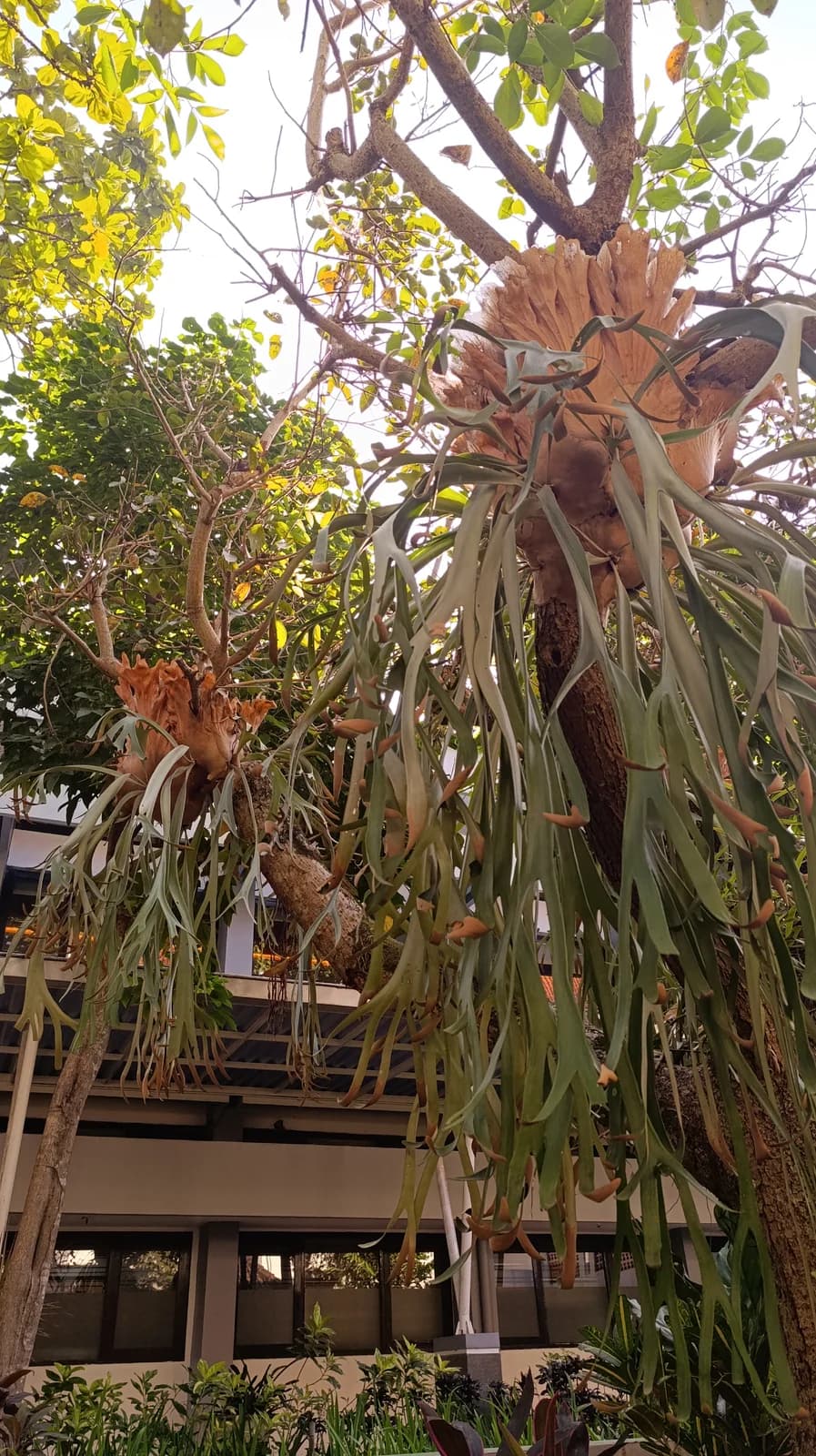
Platycerium willinckii, the Java staghorn fern, is an epiphyte of seasonally dry forest on Java and nearby Indonesian islands. Long, narrow, repeatedly forked fertile fronds hang under a coat of silver stellate hairs; the tall shields are lobed at the top. It is sun-tolerant, pups freely, and is the parent of most named cultivars collectors chase.
Care notes
Native habitat
Platycerium willinckii is an epiphyte of monsoon forest on Java and the neighbouring Lesser Sunda Islands. Its home has a real dry season, which is why willinckii tolerates strong light and short droughts better than most of the genus, and why it does so well on a bright balcony.
Light
A high-light species. Half sun to nearly full sun is ideal; the more light, the thicker the silver hair and the firmer the fertile fronds. Under glass in high summer, shade lightly at midday to protect new fronds. Indoors it needs the brightest window or a grow light, or it turns green, stretches and droops. The silver hair coating the fertile fronds is not just decorative; it is a sun-shield structure, and the thicker the coat, the more light the plant can take.
Water and humidity
Soak when dry, then let it dry again. It shrugs off a missed watering but rots if kept constantly wet. Humidity of 50–70% is plenty, far more forgiving than P. ridleyi. Air movement matters most in warm, humid rooms.
Medium and mounting
Sphagnum with bark for drainage. The shields grow tall and turn brown as they wrap the board, so mount low and leave headroom. Pups appear readily; separate them once they carry a shield of their own, or keep the clump. Dwarf cultivars take a small board but still need airflow.
Temperature and seasons (temperate, indoor)
Ideal range 18–32 °C. It handles summer heat if air moves. Growth stops below 10 °C and fronds may be damaged; below 5 °C there is real risk. In temperate climates bring it inside before the first cold nights, water less through winter, and keep the light as high as possible.
Common problems
- Silver turning green: not enough light.
- Scorched frond tips: drought or sunburn; the timing tells you which.
- Shields going brown: normal; willinckii shields brown early.
- Weak mother plant in a crowded clump: remove some pups to concentrate growth.
Collector notes
Frond expression. Number of forks, frond length ('long-hand' versus 'short-hand' in Taiwanese usage), width, angle of drop, density of stellate hair, and habit (standard or dwarf). Named dwarf lines such as 'Jade Girl', 'Bacteria', 'OMG' and 'Nano', the 'Jenny' and 'Golden Boy' lines popular in Taiwan, and moon lines such as 'Yellow Moon' are all willinckii selections or descendants. Nearly all are trade names, not registered cultivars, and the same name can sit on different clones.
Mother plant. Look for a compact, symmetrical habit, fertile fronds of even length, and uniform silver. A cultivar's value rests on the mother plant's expression and its lineage.
Propagation. Willinckii pups, so division is the reliable way to preserve a named clone. Spore-grown plants segregate into many expressions and are where new forms come from, but they do not copy the mother. Tissue-cultured plants are abundant in trade; when buying a named cultivar, confirm whether it is a division, a sporeling or tissue culture. With a named willinckii, provenance is the first thing to check.
FAQ
Why are dwarf Platycerium willinckii so expensive?
Dwarf traits show up in a small share of spore batches, take years to confirm, and vary plant to plant, so good specimens are scarce. Taiwan's 'six divine beasts' usually means dwarf lines like 'Jenny', 'Golden Boy', 'Jade Girl', 'Bacteria', 'OMG' and 'Nano', but the list is informal and shifts with the market.
Can Platycerium willinckii take full sun?
Yes, within reason. Willinckii wants half to nearly full sun, and its silver hair thickens with light. Shade it lightly at midday in high summer, and acclimatise newly mounted plants or fresh pups in filtered light for a week or two before moving them into sun.
Is 'Jade Girl' a species or a cultivar?
A cultivar, or more precisely a trade-named selection of Platycerium willinckii from Indonesia, prized for its compact habit and thick, short fertile fronds. It is not a separate species and not a registered name, so buy on the mother plant's photos and the stated propagation method, not the label alone.
For a named cultivar, should I buy a pup or a sporeling?
A pup (division) if you want the mother plant's exact expression. A sporeling if you want a lower entry price and enjoy the gamble, remembering that sporelings are offspring, not copies, and some sellers attach the mother's name to them anyway. Tissue culture gives identical copies without individuality.
How cold-hardy is Platycerium willinckii?
Hardier than ridleyi or coronarium but not frost-proof. Growth stops below 10 °C, fronds can be marked, and below 5 °C damage is likely. In temperate regions it is an indoor plant from autumn to spring: bright window, sparse watering, no cold draughts.
Is Platycerium willinckii single-crown or pupping? Can the pups be separated?
Willinckii pups freely: side buds keep appearing around the main crown, and each one can be cut away once it grows its own shield, which is the standard way to propagate it. You can also leave the pups on to grow a clump. Single-crown species such as [P. wandae](/species/wandae) and dwarf wandae never produce pups at all.
What is 'Jenny'? Is a variegated willinckii worth buying?
'Jenny' is a dwarf selection of willinckii that pups freely; every Jenny in trade traces back to divisions from the same line. Its value sits in a tight, complete habit and pup count, and a freshly separated pup needs a year and a half to two years before its form shows. Variegated willinckii is extremely rare and unstable, prone to reverting to solid green or weakening if it goes fully variegated, and it is not a good first plant for beginners.
Related species
Species often compared with, or mistaken for, this one.
Currently available
Plants of this species you can take home now.